Saxion Website Redesign
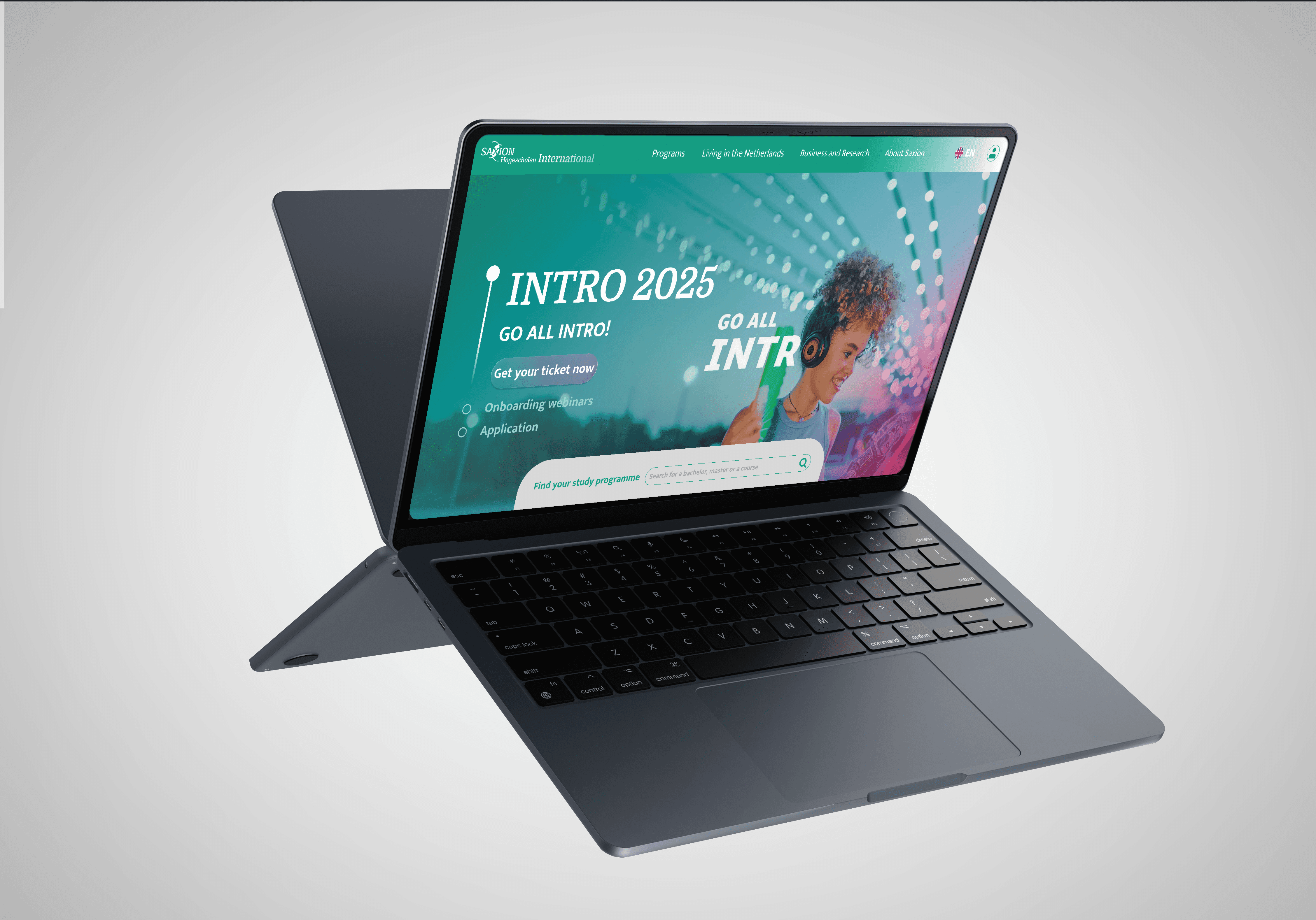
A complete redesign of Saxion University’s website focused on clearer navigation, accessibility, and user experience. The goal was to simplify complex information structures while preserving the university’s identity and academic tone.
2025
UI/UX Redesign

The Saxion University Website Redesign aimed to improve navigation, accessibility, and visual clarity across devices. The original platform served as a key touchpoint for both prospective and current students, but its fragmented structure made it difficult to find relevant information quickly and intuitively. The goal was to create a consistent, accessible, and student-oriented experience.
To address this, I conducted heuristic evaluations, competitor benchmarking, and usability testing to uncover pain points such as unclear hierarchy, cluttered layouts, and inconsistent responsiveness. Based on these findings, I restructured the information architecture around user intent—introducing pathways like Find a study, Plan your stay, and Student life—and refined the visual hierarchy to support easier scanning and decision-making.
Key Outcomes
Reduced average task completion time by 38% in usability testing.
Improved clarity and accessibility, especially for international students.
Delivered a cohesive, responsive design aligned with WCAG 2.1 standards.
Skills & Focus Areas
Information architecture and interaction design.
Accessibility-driven design and UX writing.
Data-informed iteration and usability evaluation.
The Saxion University Website Redesign aimed to improve navigation, accessibility, and visual clarity across devices. The original platform served as a key touchpoint for both prospective and current students, but its fragmented structure made it difficult to find relevant information quickly and intuitively. The goal was to create a consistent, accessible, and student-oriented experience.
To address this, I conducted heuristic evaluations, competitor benchmarking, and usability testing to uncover pain points such as unclear hierarchy, cluttered layouts, and inconsistent responsiveness. Based on these findings, I restructured the information architecture around user intent—introducing pathways like Find a study, Plan your stay, and Student life—and refined the visual hierarchy to support easier scanning and decision-making.
Key Outcomes
Reduced average task completion time by 38% in usability testing.
Improved clarity and accessibility, especially for international students.
Delivered a cohesive, responsive design aligned with WCAG 2.1 standards.
Skills & Focus Areas
Information architecture and interaction design.
Accessibility-driven design and UX writing.
Data-informed iteration and usability evaluation.